Cost Estimation for Autonomous Delivery Projects
Traditional estimation is broken because it estimates effort, not outcomes. Autonomous delivery reframes estimation around delivered capability.
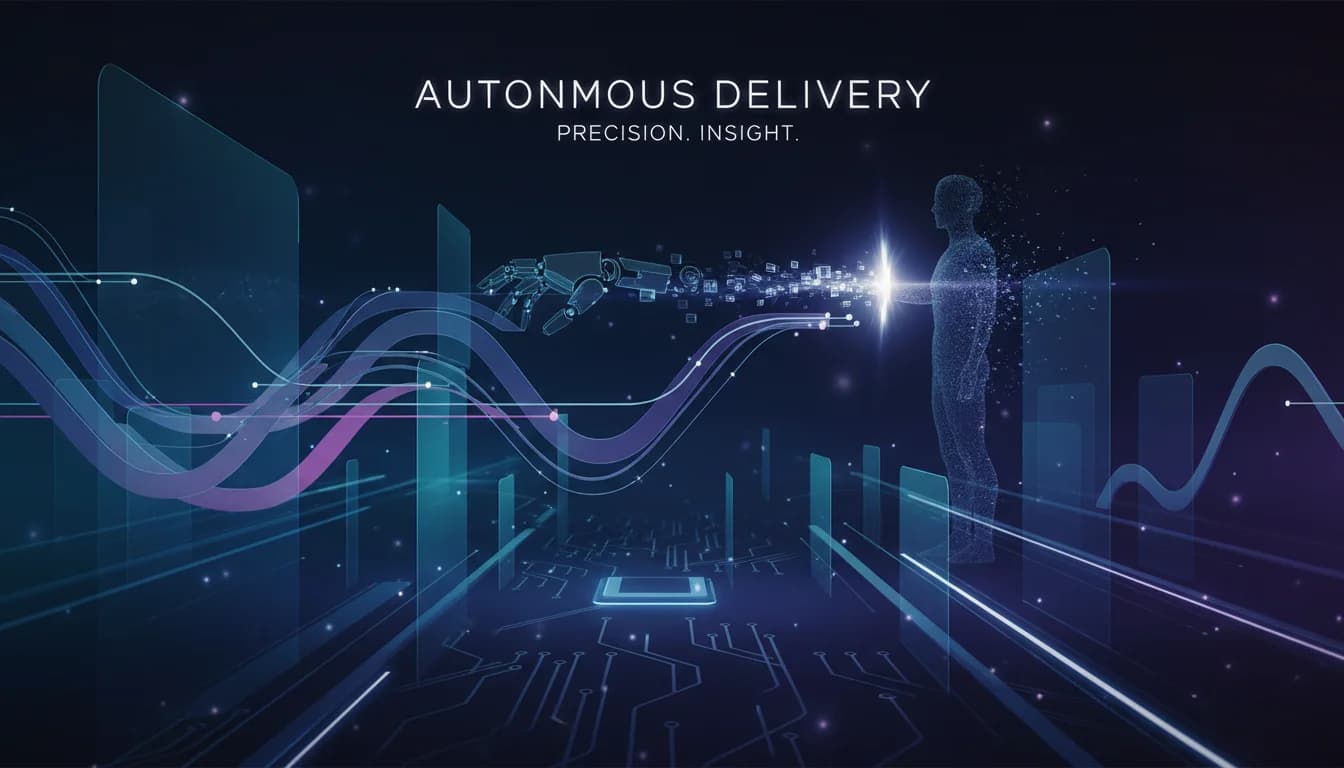
Software estimation has been the industry's biggest unsolved problem for decades. No cone of uncertainty, planning poker, or velocity-based projection has reliably predicted when software will be done or what it will cost. The fundamental issue is that traditional estimation tries to predict human effort, which is inherently variable and influenced by factors that cannot be quantified in advance.
From effort estimation to capability estimation
Autonomous delivery changes the estimation model. Instead of asking how long will it take a team to build this, the question becomes what is the scope of capability the system needs to deliver, and what are the governance constraints. The autonomous system's throughput is more predictable than human throughput because it is not affected by meetings, sick days, context switching, or motivation.
The new estimation variables
- Scope complexity: how many bounded contexts, service boundaries, and integration points
- Governance overhead: how many human review gates and approval cycles are required
- Constraint density: how many policies, compliance requirements, and architecture rules apply
- Integration depth: how many external systems must be connected and tested
- Novelty factor: how much of the system requires patterns the system has not generated before
The best estimate is a working increment delivered early enough to validate assumptions. Autonomous delivery makes the first working increment available in days rather than months, making estimation less critical and validation more frequent.
See governed autonomy in action
Request a demo and see how Team Helix applies these ideas to your engineering workflow.
Related reading

Measuring Engineering Productivity Without Vanity Metrics
Lines of code, velocity points, and commit counts tell you nothing. Here are the metrics that actually predict delivery capability.

Platform Engineering Lessons from Scaling 10x to 100x
What works at 10 engineers breaks at 50 and collapses at 200. Here are the platform engineering patterns that survive scaling.

The Quantifiable Cost of Poor Developer Experience
Developer experience is not a perk. It is a multiplier. Here are the numbers that prove investing in DX delivers measurable business returns.